El escondite como intimidad
Los pacientes del doctor GarcíaEl escondite como intimidad names the bond Guillermo García Medina and Amparo Priego Martínez first discover as children: hiding together in a confined, secret space, holding hands and whispering while the adults search outside. The game is more than a childhood pastime. It gives them a private world with its own boundary and rules, and becomes an enduring pattern through which they recognize one another amid war, concealment, and years of separation.
The childhood hiding place
Guillermo and Amparo are both being raised by their grandparents in Madrid. Amparo, a year younger, is the only child of Guillermo’s age he can regularly see outside school. They invent new games together each week, but hiding is their favorite: they squeeze into cupboards and pantries, crouch behind laundry baskets, and wait hand in hand until the adults’ calls fill the house. Guillermo says he is used to playing alone, yet prefers being with Amparo.
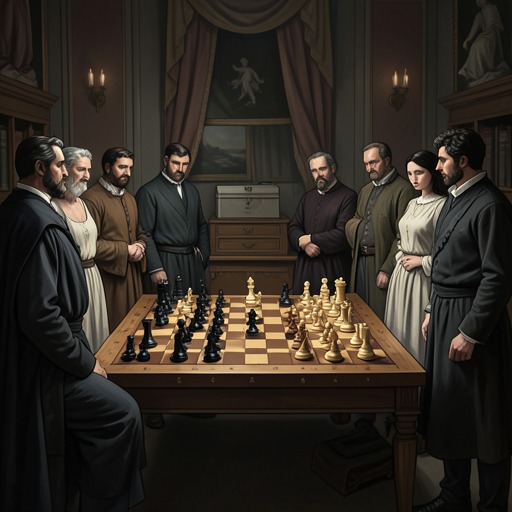
Their most cherished refuge is the hollow lower compartment of a large, custom-built bookcase in Don Fermín’s study. The cabinet’s empty interior exists because the books do not fill the shelves above it, which rise toward the ceiling in stepped tiers. While the grandfathers concentrate on their chessboard, the children crawl across the floor, ease open the central door so its hinges will not squeak, and shut it just as carefully behind them. The contrast is essential: the adults’ measured, visible contest continues above and around them, while the children make a hidden space that belongs to neither the chess game nor the household at large.
Inside the wooden compartment, stillness and excitement meet. Guillermo remembers the wax smell mingling with the chamomile infusion Amparo used to wash her hair, and the darkness becoming ambiguous and almost luminous as they breathe together. Their hands remain joined, their fingers pressing against each other. A simple door divides them from their grandparents, Experta, the meal, and the crowded street beyond the balconies; until someone opens it, that ordinary world seems to have disappeared. The hiding place therefore does not merely conceal them. It makes intimacy perceptible as a shared bodily experience, held apart from the rest of life by a fragile wooden boundary.
The game’s adult return
Years later, the childhood hiding place returns as more than a memory. In the last Sunday of March 1947, Guillermo goes to meet Amparo, who knows that the man living as Rafael Cuesta Sánchez is really Guillermo García Medina, and that he is a doctor despite lacking official credentials and working for a transport agency. She does not know that he has come to help his friend Manuel Arroyo Benítez, who has assumed Adrián Gallardo Ortega’s identity to infiltrate a Nazi escape organization and reach Argentina. Meanwhile, the real Adrián is begging in Berlin and using documents belonging to Alfonso Navarro López when stopped by patrols. In this landscape of assumed identities, Amparo’s knowledge of Guillermo’s real name is an intimate form of recognition.
The old game becomes practical as well as emotional. Amparo tells Guillermo that she has installed herself in his childhood bedroom, which she knows from their games, and describes how she had intended to remain there unseen: shut in after six each evening, shutters closed, bedside lamp lit, with a sandwich or biscuits and no noise. Her imagined routine echoes the children’s hiding place, but now the secrecy has adult stakes and is shaped by fear and precarious shelter. Guillermo points out that she has no room of her own in the house; she answers by describing the one she has made through concealment and by drawing on their shared knowledge of its rooms.
When Guillermo proposes possible alternatives, including asylum through the Anglican parish or work as a nurse in his hospital, Amparo interrupts with a proposal to make their life together like one of the games they loved: she will be a fairy who appears and disappears in a blink, and he will never see her. The childhood pattern has become a way to negotiate proximity without openly naming what it means. Guillermo answers that he does not want to see her, but the narrator immediately makes clear that this is a lie met with another lie: both remember everything. Their history supplies the understanding that their present evasions conceal.
Hiding as refuge and shared code
The hiding motif also connects intimacy with safety. When Guillermo gives Amparo instructions for a possible emergency, he tells her the house has two doors and that she can leave through the service entrance and enter her grandfather’s house through a matching door. The secret space behind the bookcase is still there; she need only wait inside for him to come and find her. Amparo objects that Guillermo does not have the keys to her grandfather’s home. He replies that Experta does, and offers to fetch them. The remembered refuge is no longer only an image of childhood closeness: it remains a specific place in a practical plan for protecting her.
The scene also shows that their code is made from details accumulated over time. The old bookcase and the route between houses matter because the two know the domestic geography from childhood, while their exchange about keys tests whether Guillermo’s reassurance can be trusted. The hiding place carries both the promise and the limit of refuge: it can conceal Amparo, but only if someone can reach the house and open the route for her. Its intimacy is inseparable from vulnerability.
Memory, secrecy, and recognition
The novel repeatedly places the childhood bond beside the identities that war forces its characters to inhabit. Guillermo’s private knowledge of Amparo coexists with his assumed name, his unofficial medical work, and the political history they have shared. In 1936 he describes living as an impostor, removing a crucifix from the wall each night and restoring it each morning, and walking across the Castellana as though the avenue divided Guillermo García Medina’s life from Rafael Cuesta Sánchez’s. Against that daily performance, Amparo’s recognition of his true identity preserves a connection to the person behind the papers.
Their past remains materially and emotionally present even when they are apart. In January 1947, after finding a name on a list, Guillermo wanders before going to Españoleto 24, where he interrupts a chess game. Later, searching an old trunk, he finds a folder containing his medical degree, a union card, a photograph with Norman Bethune, and Republican identification documents. He also finds an envelope with a family book naming Guillermo García Medina and Amparo Priego Martínez, their son’s birth record, a photograph of their wedding, and Amparo’s short apology dated March 28, 1939. The concealed family papers turn the history between them into evidence that can be recovered, though the apology leaves the circumstances it refers to unresolved.
The son’s life carries that secrecy forward. Amparo’s child is given the name José Antonio Urbieta, with an invented surname and a public story that his father was a Falangist hero killed in Russia. A photograph of the supposed father stands prominently in the house. Guillermo nevertheless watches the boy grow from a distance, seeing him arrive with scraped knees and his shirt untucked; learning that he might lose that opportunity makes the distance painful. Years later, José Antonio discovers the birth record and Republican family book hidden among his mother’s things. He also learns from Experta that Guillermo is his father, that Guillermo had hidden Amparo, and that the two had lived together until 1939. A family secret preserved in documents and partial confidences becomes a belated act of recognition.
Intimacy across time
The motif’s significance ultimately lies in its persistence, not in a return to the uncomplicated childhood game. Guillermo’s later family life does not erase his first son. When he has a child with Rita, he names him Manuel after the name shared by his parents’ best friends; the baby’s gestures revive memories of the son who had disappeared from his life, until the present child gradually changes that memory into a gentler nostalgia. The old bond is thus carried forward through a different household and another child’s name, rather than resolved by simple reunion.
On December 30, 1976, Guillermo and Manuel Arroyo Benítez meet again at the arrivals entrance of Barajas International Terminal and embrace for the first time. They are both older, marked by scars, and still do not use their true names, though each addresses the other by his authentic one. Their reunion is not the childhood hiding place restored, but it echoes the same distinction between public identity and private recognition. Across the novel, intimacy takes shape in concealed rooms, remembered gestures, hidden documents, and names spoken between people who know what lies beneath them. The children’s wooden compartment offers the original form of that knowledge: a fragile enclosure in which the outside world can be held at a distance, and another person can be known without disguise.